About
The term annealing refers to a heat treatment in which a material is exposed to an elevated temperature for an extended time period and then slowly cooled.
According to ASTM, annealing is defined as a softening process consisting of heating the steel to a temperature at or near the critical point, holding there for a proper time and then allowing it to cool slowly in the furnace itself.
Three stages of annealing process (or Annealing cycle): Any annealing process consists of following three stages:
1. Heating to the desired temperature.
2. Holding or 'soaking' at that temperature.
3. Cooling or 'quenching', usually to room temperature.
In practice, annealing is one of the most widely used processes in the heat treatment of iron and steel.
PURPOSES OF ANNEALING
Generally annealing is carried out to achieve one or more of the following purposes:
1. To relieve or remove stresses.
2. To induce softness.
3. To alter ductility, toughness, electrical, magnetic, or other properties.
4. To refine grain structure.
5. To remove gases.
6. To produce a definite microstructure.
APPLICATION
Annealing process is employed in casting, forging, rolled stock, press work, etc.
TYPES OF ANNEALING
The most common types of annealing processes applied to commercial steels are:
1. Full annealing,
2. Process annealing,
3. Stress relief annealing,
4. Recrystallisation annealing, and
5. Spheroidise annealing.
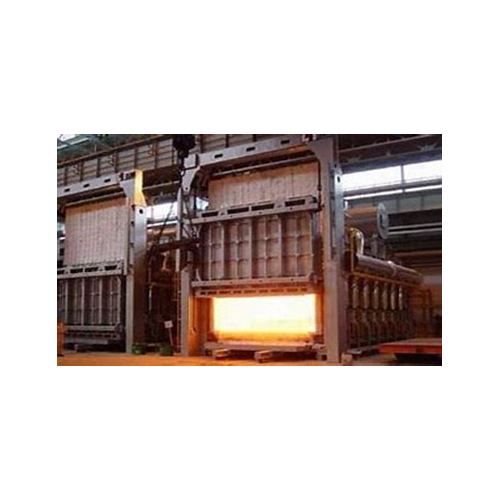
Advanced Annealing ExpertiseBenefit from specialized annealing processes, including full, process, spheroidizing, and solution annealing, designed for superior metal stress relief and enhanced material properties. Our services are ideal for a wide range of steel grades and formats, ensuring flexibility for any industrial requirement.
Flexible Service Modes and CapacityWe offer both on-site and in-house annealing with customized dimensions and weight options to suit diverse project specifications. Our systems efficiently handle up to 10 tons per batch while maintaining top-tier temperature consistency for optimal results.
Industry-Leading Standards and SustainabilityAll annealing operations adhere to stringent international standards (ISI, DIN, JIS, ASTM) and employ energy-efficient, eco-friendly technologies. Our facilities are equipped for inert gas and atmospheric annealing, ensuring reliability and safety for critical applications.
FAQs of Annealing सेवाएं:
Q: How are the different types of annealing processesfull annealing, process annealing, spheroidizing, and solution annealingapplied in your services?
A: We select the annealing method based on material type, desired mechanical properties, and end application. Full annealing provides comprehensive stress relief and softening, process annealing restores ductility for further working, spheroidizing improves machinability in high-carbon steels, and solution annealing is used for alloy or stainless steels to dissolve alloy elements and create a homogeneous structure.
Q: What is the maximum load capacity, and can you accommodate varying part sizes or shapes?
A: Our facilities are equipped to process up to 10 tons per batch, accommodating a wide range of product sizes and shapes. We support custom dimensions and configurations for plates, sheets, bars, coils, strips, and even complex custom geometries, tailored to project requirements.
Q: When and where are your annealing services available across India?
A: Our annealing services are available pan India, supported by both on-site and in-house service models. Scheduling and lead times are determined as per job complexity and client requirements, ensuring prompt turnaround wherever your facility is located.
Q: What industries and applications do your annealing services support?
A: We cater to automotive, tooling, heavy engineering, fabrication, railways, and aerospace industries. Applications include metal stress relieving, ductility improvement, and refining grain structure for finished and semi-finished steel products, ensuring compliance with diverse industrial demands.
Q: What benefits do clients gain from using your environmentally friendly, energy-efficient systems?
A: Our energy-efficient and eco-friendly annealing processes minimize resource consumption, reduce operational costs, and lower environmental impact. These systems ensure regulatory compliance and promote sustainability in industrial heat treatment operations.
Q: How is temperature uniformity maintained, and what atmosphere options are available during annealing?
A: We guarantee temperature uniformity of 5C throughout both continuous and batch furnaces. Clients can choose between inert gas and atmospheric annealing, providing precise atmosphere control suitable for different steel types and desired surface or structural properties.
Q: Can you process a variety of steel types and product grades?
A: Yes, we handle stainless steel, carbon steel, and alloy steel, conforming to ISI, DIN, JIS, ASTM, and other required standards. We process a range of thicknesses (1 mm to 100 mm), product forms (plates, sheets, tubes, coils, bars), and grades tailored to customer specifications.